

 Interview with
 Torny Gottberg (music, vocals, production) from Project-X
After some time of Scandinavian EBM shaping dancefloors with muscle and discipline, PROJECT-X still operates with a rare kind of clarity: blunt energy, clean structure, zero need to cosplay its own past. With new live shows lined up for 2026, this felt like the right moment to check in with Torny - not to ask for a nostalgic victory lap, but to talk about what survives when the “seriousness” burns off and only the essentials remain: friendship, curiosity, and that stubborn urge to make machines feel alive.
In this conversation, Torny reflects on how PROJECT-X has turned into something lighter and more deliberate, why the live element remains the project’s sharpest edge, and what he thinks the scene is missing as audiences grow older. He also addresses, as far as he’s willing, the end of his chapter with CRYO, and shares his thoughts on technology, AI, and the value of doing things the slower, hands-on way - because for him, the point was never “making it.” The point was always the process.
Reflections of Darkness [RoD]: PROJECT-X has always balanced raw EBM energy with a very deliberate sense of structure. Now that you’re preparing live shows for 2026, how has your understanding of the project’s identity evolved? What does PROJECT-X “stand for” today that it didn’t a decade ago?
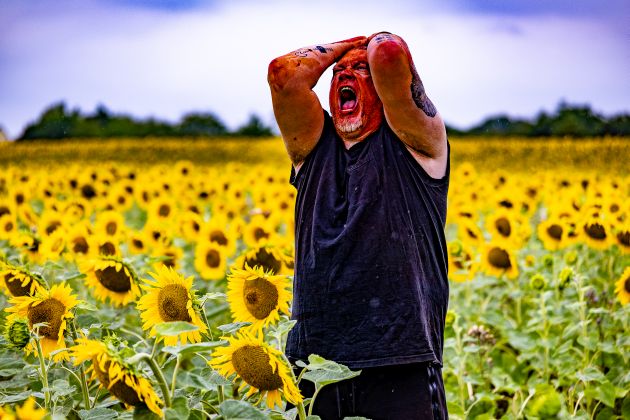
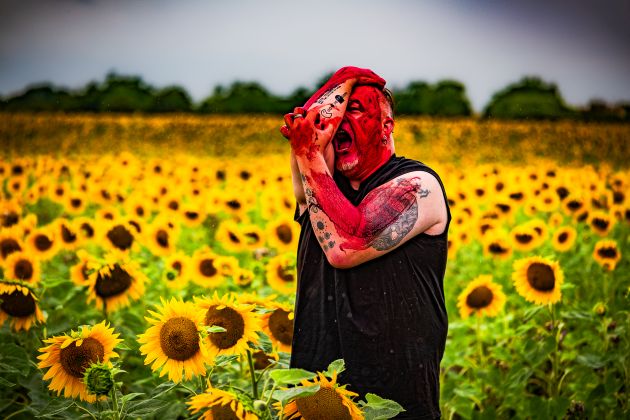
Torny: For me, PROJECT-X is simply a way of having fun with friends and has always been. I guess when we were younger we might have taken things much more seriously than we do today. Our identity nowadays is more focused on friendship and having fun. We have both passed 50 years of age, and I can see things totally different nowadays than I could back in the 90s. I mean the same “horror” thing is still there. But that’s just because I have always been a big fan of extreme and weird horror movies and still but when we were younger I think we more sought the “shock”- effect with showing autopsies on screens and stuff like that. But, you know what they say…. With age comes wisdom. So nowadays it´s more a pleasure than a must to do anything related to PROJECT-X.
RoD: Your last performance with CRYO was at Wave-Gotik-Treffen 2025 - a symbolic moment for many fans. How has stepping back from CRYO affected your artistic focus? Has it opened creative space for PROJECT-X, or shifted how you think about rhythm, sound design, or narrative in electronic music?
Torny: I haven’t commented publicly on what happened with CRYO, and I prefer to keep most of it private for now. What I can say is that the statement posted on CRYO’s Facebook page does not reflect my perspective, and I was not involved in writing it. I also did not know that the WGT show would be our final performance together. My departure had nothing to do with wanting to focus on PROJECT-X - in fact, I never intended to leave the band at all. The situation was rooted in personal issues that I don’t feel comfortable discussing openly at this time. After nearly twenty years of giving everything I could, it was painful to realize that my efforts didn’t matter in the end. That said, I’ve accepted it. I see no reason to share a stage with someone who treated me the way I was treated. It’s unfortunate that things ended this way, but I’ve moved on, and I’m focusing my energy where it’s valued.
RoD: You’ve spent years shaping the Scandinavian electronic scene - not just as an artist, but as a curator, label figure (Progress Productions), and cultural architect. Looking at 2026, what do you feel is missing in the contemporary EBM / Industrial landscape? What would you like to restore, disrupt, or reimagine?
Torny: I’m not sure really if I miss anything within the EBM scene. It is what it is and has always been. I think it really has not progressed or changed in many, many years on both good and bad. The problem is that I don’t see any younger people coming to shows, and the scene is just getting older as we are. Today, an average age is probably around 45+ at least. I would love to see 18-20 years old people attending the shows. I mean, what’s it going to be in like 10-15 years from now when festivals / shows need to change names into WWT Wave Wheelchair Treffen or something similar. Hahaha. Of course the whole AI thing also means it´s much easier to “make music” even though I think you don´t. You “prompt” music, don’t “write” it. But I guess this is the only thing I wish / miss the “next generation” so to speak. It´s funny when you play some shows, and it’s the same audience as it was in 1995/96. But then again. We are the same as well. Not really sure about what will happen to the scene in the end, though. If there is a “best before / expiring”-date or if it will “re-blossom” again.
RoD: PROJECT-X has often been described as “retro but not nostalgic.” How consciously do you navigate the tension between honouring classic EBM structures and resisting the trap of repetition? Where does evolution happen for you - in sound, in themes, or in performance?
Torny: True, I’m not a very nostalgic person at all. I don’t really think things were “better” before. Seriously, we live in such an age and time where everything is sort of easy compared to “before”. I’m not really sure if we are retro… I guess in one way we are, and in another we are not. It’s just the way we make the tracks. In a way, we learned back in the 90s. And we have sort of stuck to the routine of this. Working more with hardware synths and effects rather than virtual instruments even though I think they are really at the same class as hardware nowadays. I have just started to make new tracks for something new in 2026, and I feel it’s still really the best way for me to work in the studio.
RoD: Your work shows a strong understanding of dynamics: the push and pull between aggression, restraint, and clarity. When you compose now, what drives your decisions more: instinct, technical precision, or emotional narrative?
Torny: I really wished I had a brilliant and cool answer to this question. But honestly, I’m not really a great tech musician. I simply follow what I think sounds good. I compose tracks and have a feeling for it rather than tech-writing, checking every frequency. I think it’s really “if it sounds good, then it’s probably okay” and that’s really the way I still work in the studio. I love to experiment with effect boxes and noise to mix in the tracks. So I would say tracks really come from the joy of this.
RoD: As someone who has been part of multiple creative partnerships, how do you sense the difference between a collaboration that expands your work and one that confines it? Did the experience of CRYO shift your perspective on what collaboration should (or shouldn’t) be?
Torny: Well, with PROJECT-X I feel much more at peace and no need to stress things. The CRYO thing was probably a little more focus on growth. But I really like co/labs with other creative minds. But you sort of quickly get a feeling for if it will work out or not quite quickly. With PROJECT-X it has been around since 1994, and sure we had a few members, especially in the early years, when we maybe really did not know what we wanted to do or what we were aiming for. But for sure, I really enjoy the place I’m at right now. Me and Bjorn (PROJECT-X) have fun together and can have long talks about one or the other thing on our long drives. I think we are more at ease with ourselves nowadays. We have nothing to prove and we know we are too old to be “rockstars”.
RoD: With live concerts planned for 2026, what aspects of performance have become essential to you? Do you see PROJECT-X on stage as a physical extension of the sound, a theatrical concept, or a direct communication with the audience?
Torny: We have a few shows booked and confirmed for 2026. Not often do we play live in Sweden, but we will make an exception in February, and then for E-Only. Then there are a few others in the making. As long as we feel it’s something fun we both enjoy, we will do it for sure. We just performed at BIM-fest, and it was really a nice experience. Very nice people, and the show went down well. The live-part has always been VERY important for us. I guess in one way it is way more powerful than the records as the live-part adds the energy and edge you might have a hard time feeling in the studio. But for sure we want the sound of PX to reflect in our live shows. I have never understood why someone wants to be on stage standing completely still and not enjoying it. I normally say “Do the show WITH the audience and not AGAINST the audience” then everyone will have more fun for sure.

RoD: Many classic EBM acts return now with “heritage versions” of their sound. You’ve never seemed interested in that path. What keeps you moving forward creatively, and what do you think audiences underestimate about the complexity of EBM as a genre?
Torny: Well, in a way I guess we are already in that segment as we do play a lot of older material. But well, new things are coming, it just takes time, like everything else in life. Making music should be fun and not something “we have to do” as we both have fulltime jobs on the side and I also have the label which takes up a lot of time for me. But I think the joy of creating is still what drives us forward. The ever going experiments what happens with THAT sound if you put THAT distortion on it etc. It’s a hard question to answer about the complexity. I would say there are both kinds of the band. Technical and more straight forward. And the one and other is equally right. I mean the “old school EBM” is not as technical as, for example, FRONT 242 was during ‘Tyranny For You’. Even though I have to say. Listening to for example NITZER EBB’s ‘Belief’ proves that sometimes “less can be more”. That album is almost as perfect as EBM will get in my eyes. I’m not really sure the EBM scene cares so much about how the music is made as long as it gets you something. I know at least I’m like that. Music can be whatever as long as I get a feeling or anything. Then music has a value.
RoD: Technology - from analogue gear to AI-driven tools - is reshaping production habits across electronic music. Are there tools or methods you’ve embraced recently that changed how you work? And how do you keep technology serving expression rather than replacing it?
Torny: Nahhh… for me I’m to music of an old-school way of working as I wrote a little bit earlier. The AI thing is not for me at all. I have no direct fear of AI, but I still have no interest in it either. For me, it’s the creative part that’s the journey. Not telling the computer “I want a song about a dirty steel factory outside Dresden, and it should be hard bassline driven” and it creates it. It’s like losing the whole idea of music - at least for me. AI is a nice thing. I’m not just sure it should be used in art. But then again. People think synthesizers and drum machines are also “fake instruments”. But for that, I at least have to program the machines and make the sounds etc. I wrote in 1996 the line “We feed society with technology - but the system is dead”. In one way I still think I was on to something there. Today everyone wants to “make it” and it’s so important to “be someone”. Honestly. Just be the best version of yourself. The rest will take care of itself.
RoD: If you could articulate one guiding principle that anchors PROJECT-X in 2025/2026 - not a slogan, but a creative philosophy - what would it be? And how does that philosophy translate into the sound we will hear live next year?
Torny: Have fun, be curious, spill more blood. And I guess that’s exactly what we will do in 2026. We are really looking forward in seeing as many as possible out there next year.
RoD: Thank you for your time and see you at E-only Festival.
All Pictures by Alex Jung